
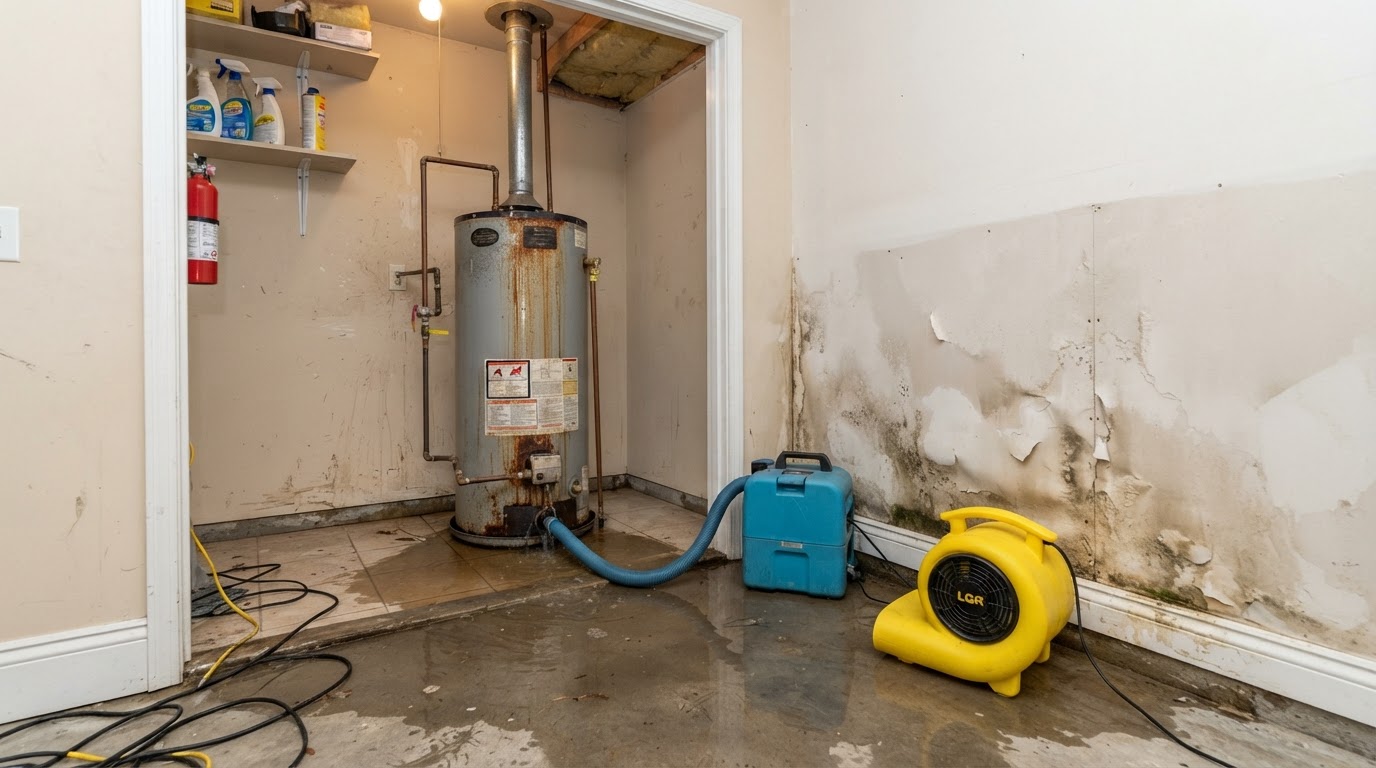
Water Heater Leak Cleanup in New Braunfels, TX
Rapid water extraction and structural drying after a water heater tank, connection, or supply line leak — addressing water that has spread across utility rooms, garages, and closets into adjacent drywall, baseboards, and flooring across New Braunfels properties.
Water heater leak cleanup is the removal of water released by a leaking or failed water heater, followed by drying of the drywall, baseboards, flooring, and subfloor the water has contacted. A leaking tank can release tens of gallons in minutes, and that water does not stay in the utility closet — it flows under the baseboard, seeps beneath adjacent flooring, and wicks into nearby drywall. After the leak source is stopped, cleanup focuses on extracting the standing water and drying the materials around the heater before secondary damage develops.
What a Water Heater Leak Does to a Property
A water heater leak is uniquely disruptive because of where heaters are located and how much water they hold. Most residential heaters sit in a utility closet, a garage corner, or an attic mechanical closet — tight spaces where leaking water has nowhere to go but outward into the surrounding structure. A failed tank drain, a corroded connection, or a burst supply line can empty the entire tank across the floor in minutes, and that water immediately travels under baseboards and into the drywall and flooring of the adjacent room.
Because heaters are often in enclosed or out-of-sight spaces, leaks sometimes run for hours before they are noticed. By the time water is visible, it has commonly already migrated beneath the adjacent flooring, soaked the lower drywall of the surrounding walls, and pooled against the baseboard and toe kick of nearby cabinets. The visible puddle is frequently only a fraction of the moisture that has already absorbed into the structure.
Cleanup after a water heater leak is separate from addressing the heater itself. The restoration team handles the water the heater released — the extraction, the drying of affected drywall and flooring, and the evaluation of which materials can be saved. Repairing or replacing the failed heater is a plumbing matter. After the leak source is stopped or repaired, the focus shifts to drying the property damage the leak caused.
What should I do when my water heater leaks?
First, shut off the power and water supply to the heater if it is safe to reach the shutoff — typically a valve on the cold inlet pipe and the electrical breaker or gas supply. Avoid contact with standing water near electrical components or a gas heater. Move any unaffected belongings away from the wet area, and place a bucket or towels to limit spread if the leak is active. Then contact a water damage cleanup team for extraction and drying, and a plumber to address the heater itself. Do not attempt to dry the structure with a household fan alone — moisture beneath flooring and inside drywall requires professional drying.
Call now to check immediate availability for water heater leak cleanup in new braunfels, tx.
Call 830-356-3743Where Water Heater Leaks Spread
Water heater leaks behave differently depending on where the heater is installed, but the pattern is consistent: water escapes the immediate area and migrates into adjacent materials. These are the locations and materials most commonly affected in New Braunfels homes.
Utility Closet Drywall
Drywall on the walls surrounding the heater wicks water upward through its paper facing. The lower portion of the wall softens, and baseboards hide moisture that travels along the bottom plate of the framing.
Adjacent Room Flooring
Water flows under the closet door and into the adjacent room's flooring. Laminate, engineered wood, and carpet padding absorb it, and moisture seeps beneath the flooring into the subfloor below.
Garage Slab & Drywall
For garage heaters, water spreads across the concrete slab and soaks the lower drywall of any shared interior wall. Concrete holds moisture that can re-wet finished flooring installed over the slab.
Baseboards & Trim
Baseboards and door trim absorb water along their lower edge and hide moisture in the gap between the wall and floor. Swelling, staining, or a spongy feel indicates trapped water behind them.
Nearby Cabinets
If the heater is near kitchen or vanity cabinets, water pools in the toe-kick space and soaks the cabinet base and particleboard components, which swell and lose structural integrity when wet.
Subfloor Beneath Flooring
Once water passes beneath the finished floor, it reaches the plywood or OSB subfloor. A saturated subfloor can delaminate or warp, and it must be dried before any flooring is reinstalled above it.
A useful rule: if the water heater is in a closet or garage corner, assume the water traveled at least one room further than the visible puddle suggests. Moisture meters confirm how far water has migrated beneath flooring and behind baseboards before drying is planned.
The Water Heater Leak Cleanup Process
Cleanup after a water heater leak follows a sequence that stops the loss, removes the water, and dries the structure around the heater. The process adapts to where the heater is located and how far the water has migrated.
1. Safety & Source Confirmation
Electrical and gas hazards near the heater are addressed first, and the water supply to the heater is confirmed shut off. The leak source — tank, connection, or supply line — is identified so the team knows the water has stopped before drying begins.
2. Standing Water Extraction
Pooled water around the heater base is removed with portable extractors. Water that has flowed under baseboards and into adjacent flooring is reached with weighted and crevice tools that pull it out before it absorbs deeper.
3. Moisture Detection
Moisture meters and thermal imaging map how far water migrated into the surrounding drywall, under the adjacent flooring, and into the subfloor. This defines the real scope of the loss, which is usually larger than the visible puddle.
4. Affected Material Evaluation
Drywall, baseboards, cabinets, and flooring are evaluated for whether they can be dried in place or must be removed. Swollen particleboard cabinets, saturated insulation, and delaminated subfloor sections are identified for controlled removal.
5. Structural Drying
Air movers and dehumidifiers are placed to dry the wall cavities, subfloor, and remaining materials around the heater. Equipment targets the concealed spaces where water migrated, not just the open floor where it pooled.
6. Monitoring & Restoration Planning
Moisture is tracked across visits until the drywall, subfloor, and framing return to an acceptable dry baseline. A restoration plan then outlines any drywall repair, flooring replacement, or cabinet work needed to finish recovery.
Why Drying Around a Water Heater Matters
The visible puddle around a water heater is the easiest part of the loss. The harder problem is the water that has already migrated beneath the adjacent flooring, behind the baseboards, and into the lower drywall — moisture that no mop or household fan can reach. Without controlled evaporation and dehumidification, that residual moisture stays inside the assemblies and causes warped flooring, stained baseboards, and conditions favorable to microbial growth in the weeks after the leak.
Structural drying is what addresses that hidden moisture. It depends on the materials involved, how much water the heater released, and how far it migrated before extraction began. A utility closet with a small, promptly-stopped leak may dry in less time than a garage heater that emptied a full tank across the slab and into shared drywall. The structure is considered dry only when readings confirm affected materials have returned to an acceptable baseline.
Because a water heater leak often involves a plumbing failure, this page connects to related services. Emergency water removal handles the extraction stage, plumbing leak cleanup addresses the broader category of pipe and supply line failures, and structural drying completes the project after the water is gone.
Request water removal assistance for your New Braunfels property.
Water Heater Leak Cleanup FAQs
Direct answers about water heater leak cleanup, what gets damaged, and how the structure is dried after the leak is stopped.
What should I do when my water heater leaks?
Shut off the power and water supply to the heater if it is safe to reach the shutoff, and avoid contact with standing water near electrical or gas components. Move unaffected belongings away from the wet area and limit the spread if the leak is active. Then contact a water damage cleanup team for extraction and drying, and a plumber to address the heater. After the leak source is stopped, the focus is drying the property damage the leak caused.
Who removes water after a water heater leak?
A water damage restoration team removes the water the heater released and dries the affected drywall, baseboards, and flooring. The heater itself — repair or replacement — is handled by a plumber. The restoration team focuses on the water damage to the structure, which is a separate issue from the failed appliance. Contact the team as soon as possible after the leak is stopped.
Can a leaking water heater damage drywall?
Yes. Drywall on the walls surrounding the heater wicks water upward through its paper facing, and the lower portion softens and loses strength. Baseboards hide moisture that travels along the bottom plate. Affected drywall is evaluated for whether it can be dried or whether the lower section must be cut out to open the wall cavity for airflow.
Can water from a water heater get under flooring?
Yes, frequently. Water flows under the closet door or across the garage slab and seeps beneath adjacent flooring — laminate, engineered wood, tile, or carpet — into the underlayment and subfloor below. Moisture meters confirm whether water remains trapped beneath the finished floor before drying is considered complete.
Does water heater flooding require structural drying?
Yes. After standing water is extracted, moisture remains inside the surrounding drywall, subfloor, and framing that no pump can reach. Air movers and dehumidifiers evaporate that residual moisture over several visits. Without structural drying, hidden moisture in the wall and subfloor causes warped flooring and conditions favorable to microbial growth.
What should happen after the water heater leak is stopped?
After the leak source is stopped or repaired, the standing water is extracted, the full extent of moisture is mapped with detection tools, and the affected drywall, baseboards, and flooring are dried with controlled air movement and dehumidification. Materials are evaluated for salvage or removal, and a restoration plan outlines any drywall repair or flooring replacement needed to finish recovery.
Can a water heater leak damage nearby cabinets?
Yes. If the heater is near kitchen or vanity cabinets, water pools in the toe-kick space and soaks the cabinet base and any particleboard components. Particleboard swells and loses structural integrity when wet, and affected sections may need removal. Cabinets are evaluated for whether they can be dried and resealed or must be replaced.
How quickly should water around a water heater be removed?
As soon as it is safe to do so. Water from a heater leak begins absorbing into drywall, baseboards, and flooring within minutes, and the longer it sits the deeper it migrates into the subfloor and wall assemblies. The sooner bulk water is extracted, the more materials can typically be saved and the shorter the drying phase. Contact the team as soon as possible after discovering the leak.
Water Heater Leak in Your New Braunfels Home?
Call now to check immediate availability for water extraction and structural drying after a water heater leak — protecting your drywall, flooring, and subfloor from hidden moisture across New Braunfels and Central Texas.
New Braunfels Water Damage Restoration
830-356-3743