Commercial Water Damage Restoration in New Braunfels, TX
Large-loss water extraction, moisture evaluation, and structural drying for offices, retail spaces, restaurants, warehouses, and multifamily common areas — coordinated to limit operational disruption across New Braunfels-area commercial properties.
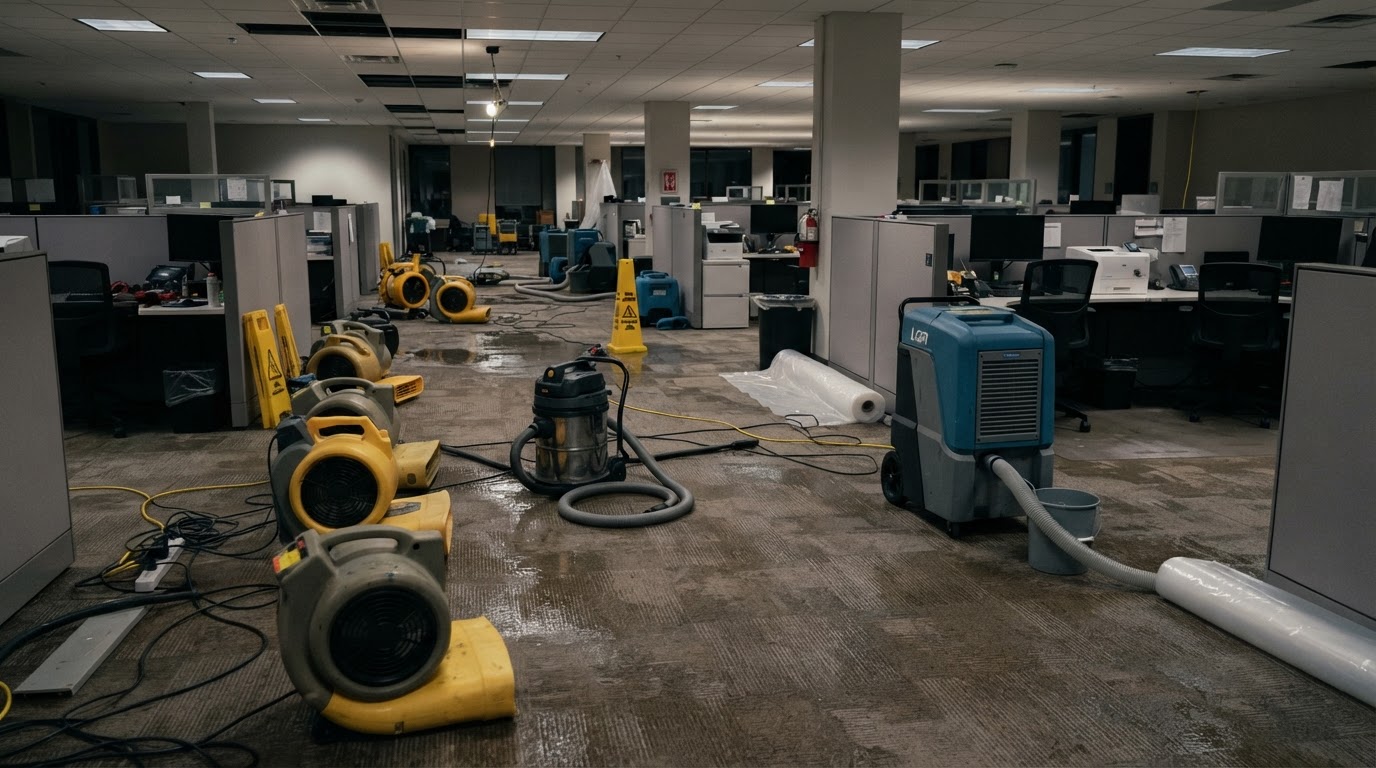
Commercial water damage restoration is the process of removing water from a business property, evaluating how far moisture has migrated into commercial building materials, and drying the structure while limiting disruption to operations. Because commercial buildings have larger floor plates, shared walls between tenants, and contents that affect downtime, the approach prioritizes rapid extraction, targeted containment of the affected area, and drying strategies that can allow parts of the property to keep operating where safe.
What Commercial Water Damage Restoration Involves
Water damage in a commercial property is not simply a larger version of a residential loss. A burst line on an upper floor of an office building can feed water down through ceiling cavities and wall chases across multiple tenant spaces. A flooded retail stockroom can saturate inventory, packaging, and finished flooring at the same time. A restaurant leak can introduce water into a kitchen with food-safety surfaces and equipment that cannot simply be wet. The building type changes what is at risk and how the cleanup must be sequenced.
For property managers, building managers, and business owners in New Braunfels, the priority is usually twofold: stop the water and limit the affected area. Containing the loss to the smallest practical footprint protects unaffected tenant spaces, inventory, and operations. That means early moisture evaluation matters even more in a commercial setting — moisture that migrates into an adjacent suite, a shared wall assembly, or the subfloor beneath commercial tile can extend both the drying timeline and the business interruption if it is not found.
Commercial restoration also involves contents and materials that residential work does not: larger volumes of flooring, suspended ceilings, raised access floors, tenant build-outs, and shared mechanical systems. Evaluating what can be dried, what must be removed, and what must be temporarily relocated is part of planning the project around the business rather than treating the building as an empty box.
What should a business do after discovering water damage?
After discovering water damage, a business should first address any electrical or slip hazards and keep employees and customers away from the affected area. Stop the water source if it is safe and identifiable, move unaffected inventory or equipment out of the wet area if possible, and document the damage for your records. Then contact a commercial water damage restoration team for extraction, moisture evaluation, and drying. Avoid operating in standing water or near energized electrical equipment, and do not assume an adjacent tenant space is unaffected just because it looks dry.
Call now to check immediate availability for commercial water damage restoration in new braunfels, tx.
Call 830-356-3743How Water Moves Through Commercial Buildings
Commercial buildings are built differently than homes — larger floor plates, shared walls, suspended ceilings, and multi-story construction all change how water migrates. These are the materials and pathways most commonly involved in New Braunfels commercial water damage projects.
Commercial Flooring
Large-format tile, commercial glue-down carpet, VCT, and polished concrete all absorb and transmit water differently. Water beneath commercial tile travels across the slab and can wick into adjacent rooms and tenant spaces.
Suspended Ceilings
Drop-in ceiling tiles and grid systems hide the path water takes from an upper floor or roof leak. Wet tiles sag and collapse, and water pools above the grid before traveling down interior walls.
Shared & Demising Walls
In multi-tenant buildings, water migrates through wall cavities and along shared framing between suites. A leak in one unit frequently means hidden moisture in the adjacent unit's walls and subfloor.
Subfloor & Concrete Slab
Concrete is porous and holds large volumes of water. On ground-floor commercial spaces, water saturates the slab and re-wets finished flooring installed above it unless it is dried before recovery.
Tenant Contents & Inventory
Retail stock, files, equipment, and restaurant supplies absorb water and can transfer dyes, inks, or contaminants. Salvageable contents are relocated; unsalvageable items are documented for removal.
Multi-Story Migration
In two- and three-story commercial buildings, water follows gravity down through wall cavities, pipe chases, and floor penetrations. A leak on an upper floor commonly affects the ceiling and walls of the space below.
A common mistake in commercial losses is assuming the damage is limited to the room where water is visible. Because commercial floor plates are large and shared assemblies connect tenant spaces, moisture evaluation across adjacent units, the floor below, and the subfloor is part of defining the real scope of the loss before drying equipment is placed.
The Commercial Water Damage Restoration Process
Commercial restoration follows a sequence that prioritizes safety and containment, then systematically extracts, evaluates, and dries the structure. The process is adapted to the building type and the need to keep unaffected areas operational where possible.
1. Safety & Operational Assessment
Electrical, slip, and contamination hazards are addressed first. The affected area is identified and, where possible, contained so unaffected tenant spaces and operations can continue safely while the loss area is addressed.
2. Containment & Source Stabilization
The water source is confirmed stopped, and the wet area is contained to limit moisture migration into adjacent suites and shared wall assemblies. In multi-tenant buildings, neighboring spaces are checked for hidden moisture.
3. Commercial Water Extraction
High-volume extractors and pumps remove standing water from large floor areas. Specialized tools reach water beneath commercial flooring, into stockrooms, and across wide floor plates more efficiently than residential equipment.
4. Moisture Mapping & Material Evaluation
Moisture meters and thermal imaging map the full boundary of affected commercial assemblies — flooring, subfloor, walls, ceilings, and cavities. Materials are evaluated for drying versus removal based on condition and water source.
5. Structural Drying & Dehumidification
Commercial-grade air movers and dehumidifiers are placed across the affected area, including wall cavities, subfloors, and ceiling plenums. Drying targets concealed assemblies where moisture migrated, not just open floor space.
6. Monitoring & Recovery Planning
Moisture levels are tracked across visits until affected materials return to an acceptable dry baseline. A recovery plan then outlines cleaning, repair, flooring replacement, and any reconstruction needed to return the space to operation.
Drying, Business Continuity & Related Services
Extracting the visible water from a commercial property is only the beginning. Moisture that has absorbed into commercial flooring, the concrete slab, wall assemblies, and ceiling cavities cannot be pumped out — it must be evaporated through controlled air movement and removed from the air with dehumidification. Skipping that stage is the most common reason commercial water damage returns as warped flooring, musty odors in stockrooms, or hidden microbial growth in ceiling plenums weeks after the visible water appeared gone.
Business continuity is a central concern. Where the loss can be contained to one area, drying is sequenced to allow unaffected operations to continue. Where the entire space is affected, the goal is the shortest safe drying timeline — but timelines depend on the volume of water, the commercial materials involved, how far moisture migrated, and indoor humidity. No exact drying duration can be guaranteed in advance, because the structure is only dry when readings confirm it.
Because commercial losses often overlap several service types, this page connects to related services. Large-volume extraction is supported by dedicated emergency water removal, extended drying relies on structural drying expertise, and a flood event may require full flood cleanup alongside the commercial restoration process.
Request water removal assistance for your New Braunfels property.
Commercial Water Damage Restoration FAQs
Direct answers for New Braunfels property managers, business owners, and facility managers about commercial water extraction, drying, and business continuity.
What should a business do after discovering water damage?
Address electrical and slip hazards first and keep employees and customers away from standing water. Stop the water source if it is safe and identifiable, move unaffected inventory or equipment out of the wet area if possible, and document the damage. Then contact a commercial water damage restoration team for extraction, moisture evaluation, and drying. Do not operate in standing water or near energized electrical equipment.
Can commercial buildings be dried while parts remain operational?
Often yes, when the loss can be safely contained to one area. Drying is sequenced to keep unaffected tenant spaces and operations running while the wet area is extracted and dried. Where the entire space is affected, the goal is the shortest safe drying timeline. The approach depends on the extent of the loss, the building layout, and whether the affected area can be isolated without spreading moisture or safety hazards.
How is commercial water extraction performed?
Commercial extraction uses high-volume pumps and extractors suited to large floor plates and standing water across wide areas. Specialized tools reach water beneath commercial flooring, into stockrooms, and along baseboards. The goal is to remove bulk water quickly to limit absorption into the concrete slab, subfloor, and wall assemblies before structural drying takes over.
What causes commercial water damage?
Common causes include plumbing line failures, roof leaks during heavy rain, HVAC or condensate drain overflows, supply line breaks to restrooms and kitchens, water heater failures, and appliance leaks in break rooms or restaurants. In multi-tenant buildings, a failure in one unit often affects neighboring spaces through shared walls and floor assemblies.
How does water affect commercial flooring?
Commercial glue-down carpet, VCT, large-format tile, and polished concrete all respond differently. Water beneath commercial tile travels across the slab; glue-down carpet releases its adhesive; and concrete holds moisture that re-wets finished flooring above it. Flooring is evaluated for whether it can be dried in place, relayed after drying, or must be removed based on the water source and condition.
Can water travel between commercial units?
Yes. In multi-tenant buildings, water migrates through wall cavities, along shared framing, and beneath shared flooring. A leak in one unit frequently means hidden moisture in an adjacent unit's walls or subfloor. Moisture evaluation across neighboring spaces is part of defining the real scope of a commercial loss before drying is considered complete.
How long does commercial structural drying take?
Commercial drying commonly takes several days, but no exact timeline can be guaranteed because it depends on the volume of water, the materials affected, how far moisture migrated, and indoor humidity. Commercial concrete slabs and large floor plates often dry more slowly than residential framing. Drying is complete only when moisture readings confirm affected materials have returned to an acceptable dry baseline.
Do commercial properties need moisture monitoring after extraction?
Yes. After extraction, residual moisture remains inside commercial flooring, the slab, wall assemblies, and ceiling cavities. Monitoring across visits confirms that concealed moisture is evaporating and that the structure is reaching dry baseline before equipment is removed. Without monitoring, hidden moisture in cavities and subfloors can cause secondary damage after the visible water is gone.
Water Damage Affecting Your New Braunfels Business?
Call now to check immediate availability for commercial water extraction, moisture evaluation, and structural drying designed to limit downtime across New Braunfels and Central Texas commercial properties.
New Braunfels Water Damage Restoration
830-356-3743